Rotational vs capillary viscometers: how viscosity is measured and which to pick
Capillary viscometers time a liquid flowing under gravity; rotational viscometers measure torque on a spinning part. See what each measures and when to use which.
Viscosity is a liquid's resistance to flow, and it matters in oils, paints, syrups, pharmaceutical liquids and many other products. Two instrument families dominate routine laboratories: capillary viscometers and rotational viscometers. They measure different things in different ways, so choosing the wrong one can give results that are hard to compare or simply not valid for your sample.
Two kinds of viscosity
The European Pharmacopoeia defines dynamic viscosity as the shearing stress needed to move one layer of liquid relative to another at a given rate of shear. Its unit is the pascal second (Pa·s), with the millipascal second (mPa·s) most commonly used [1]. Kinematic viscosity is the dynamic viscosity divided by the density of the liquid at the same temperature, and it is usually expressed in square millimetres per second [1].
In older literature you will still meet centipoise (cP) for dynamic viscosity and centistokes (cSt) for kinematic viscosity [2]. The two are linked through density, so the same liquid gives different numbers in each system unless you know its density [2].
Newtonian and non-Newtonian liquids
A Newtonian liquid has the same viscosity whatever the shear rate; lubricating oils, glycerin and alcohol are given as examples [2]. A non-Newtonian liquid changes viscosity with shear, which is typical of products such as ketchup [2]. This single distinction decides much of the choice. The European Pharmacopoeia says a capillary viscometer may be used for Newtonian liquids, whereas a rotating viscometer can be used for both Newtonian and non-Newtonian liquids [1].
How a capillary viscometer works
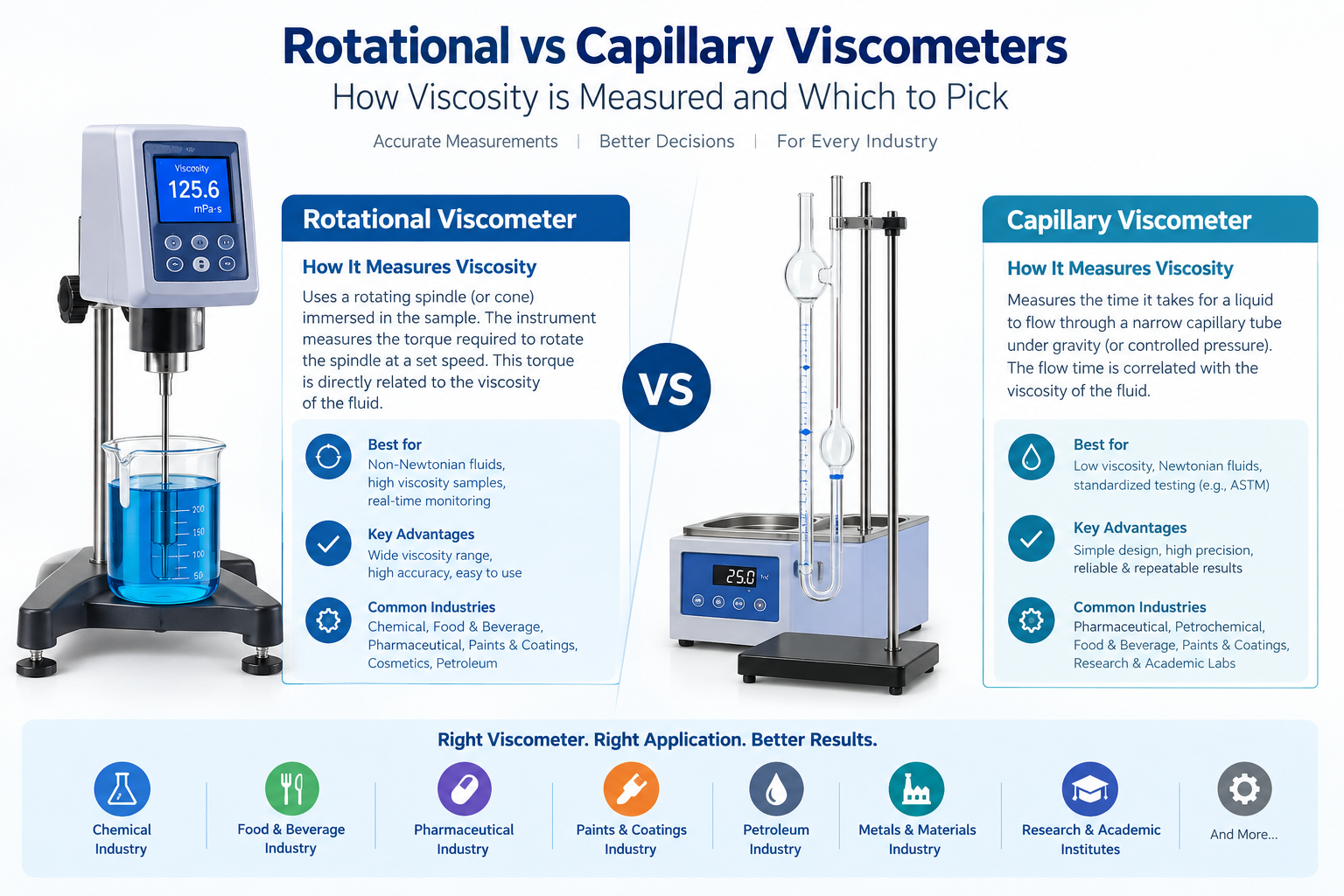
Ostwald and Ubbelohde viscometers are glass U-tubes held vertically in a temperature-controlled bath. The liquid flows through a narrow capillary between two marks, and the flow time gives the kinematic viscosity [3]. In the pharmacopoeia method, the viscometer constant is determined with a calibration liquid, and kinematic viscosity is the constant multiplied by the flow time [1].
The method is simple but needs discipline [1][3]:
The measurement is done at 20 ± 0.1 °C unless otherwise prescribed, so tight bath control is essential.
Flow time is measured with a stopwatch to the nearest one-fifth of a second.
Two consecutive readings must not differ by more than 1 per cent, and the flow time is the average of at least three readings.
Each viscometer size covers only a limited range. In the pharmacopoeia table, size 1 is intended for roughly 3.5 to 10 mm²/s, while size 5 covers 20,000 to 100,000 mm²/s, so you may need several capillaries.
The flow time should not be too short: the minimum is 350 s for size 1 and 200 s for the other sizes.
The flow has to stay laminar, and opaque or staining liquids can make the marks hard to read [3].
Because gravity is the only driving force, capillary instruments give kinematic viscosity under one fixed condition [2][3].
How a rotational viscometer works
A rotational viscometer measures the torque needed to turn a rotor at a constant rotational speed in the liquid [1]. Common designs include spindles, concentric cylinders (cup and bob) and cone-and-plate geometries [3]. The result is dynamic viscosity [2].
For non-Newtonian liquids the pharmacopoeia says it is indispensable to state the shear stress or shear rate at which the viscosity was measured [1]. A value without its shear rate is incomplete. Rotational instruments can also need regular calibration and maintenance [3].
Which one should you pick?
| Question | Leans towards capillary | Leans towards rotational |
|---|---|---|
| Sample behaviour | Newtonian liquid [1] | Newtonian or non-Newtonian [1] |
| Result you need | Kinematic viscosity [3] | Dynamic viscosity [2] |
| Shear dependence | Single flow condition only [3] | Can be measured at chosen speeds [1] |
| Temperature control | Precise bath required [1][3] | Required too; check how the instrument handles it [3] |
A viscometer measures under one flow condition. If the product's behaviour changes strongly with flow and you need the full picture, the instrument you need may be a rheometer rather than a viscometer [3].
Quick checklist
Identify whether your liquid is Newtonian; if unsure, test at more than one speed on a rotational instrument.
Check which result your specification or standard calls for: kinematic or dynamic, and at what temperature.
Estimate the viscosity range so you can choose the right capillary size or spindle.
Plan temperature control; viscosity changes strongly with temperature.
Calibrate with a reference liquid of known viscosity and record the date.
Note the shear rate or speed with every non-Newtonian result.
Check the density if you need to convert between kinematic and dynamic values.
Conclusion
Use a capillary viscometer for Newtonian liquids when you need kinematic viscosity under tightly controlled temperature; use a rotational viscometer when you need dynamic viscosity, when the liquid is non-Newtonian, or when you want to compare different shear rates. Always follow the method named in your specification and the instrument manufacturer's manual. This article is general guidance and not a substitute for either.
Sources
- European Pharmacopoeia 7.0 - chapters 2.2.8 Viscosity, 2.2.9 Capillary viscometer method, 2.2.10 Rotating viscometer method (PDF extract) (read 2026-10-20)
- CSC Scientific - What is the difference between dynamic and kinematic viscosity? (read 2026-10-20)
- chemeurope - Viscometer (encyclopedia) (read 2026-10-20)