Laser diffraction particle size analysis: how it works and what results mean
How laser diffraction turns scattered light into a size distribution, what Dv10, Dv50 and Dv90 tell you, and why optical models and sampling matter.
Laser diffraction is one of the most widely used methods for measuring the size of powders, suspensions and emulsions, from pharmaceutical actives to cement and pigments. A single measurement takes under a minute, but reading the report correctly needs a little background. This article explains the principle, the numbers on a typical report and the choices that affect them, using Malvern Panalytical's technical material and the ISO 13320 scope description.
The principle: angle tells you size
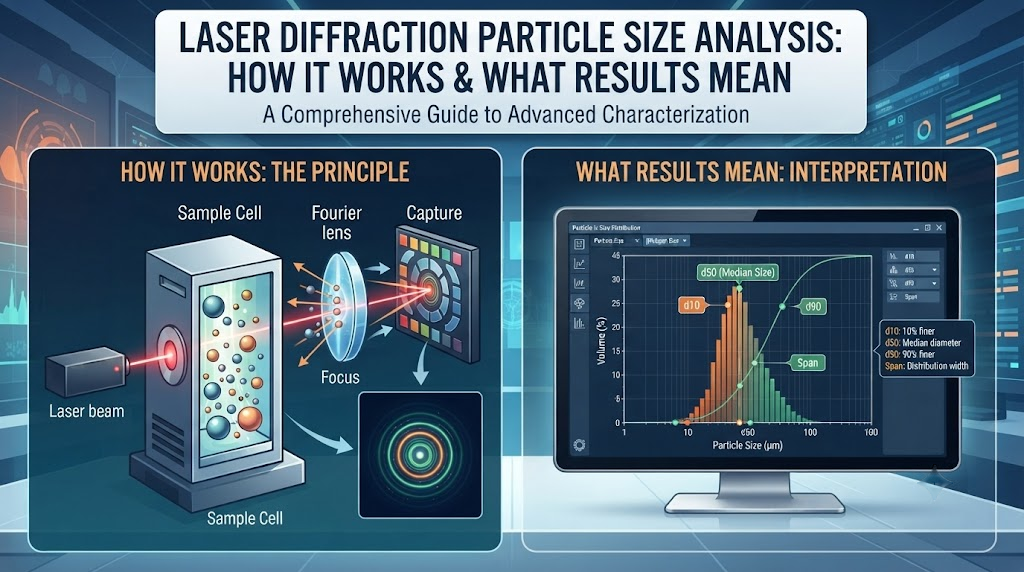
A laser beam passes through a dispersed sample, and the instrument records how the intensity of the scattered light varies with angle. Large particles scatter light at small angles to the beam, and small particles scatter it at wider angles [1]. Software then works backwards from the measured pattern to the particle sizes that would produce it, using an optical model [1]. The result is reported as the diameter of a volume-equivalent sphere [1]. Malvern describes the technique as suitable for materials from hundreds of nanometres up to several millimetres, with measurements taking less than a minute and good repeatability because a very large number of particles is sampled each time [1].
Mie theory and Fraunhofer: which model, and why it matters
Two optical models are in common use. Mie theory is a full solution of how light is scattered by a sphere; it needs the refractive index of the particle (including its absorption) and of the dispersant [1][2]. The Fraunhofer approximation is simpler and needs no optical properties of the sample, but it is accurate for large particles only and should be used with caution below about 50 µm or for relatively transparent particles [1][2]. Malvern's whitepaper notes that the ISO 13320 standard recognises the superiority of Mie theory and recommends it over the whole range of 0.1 to 3000 µm [2]. If the sample's refractive index is not known, it can be measured or estimated by fitting the model to the data [1]. In practice, record the refractive index values you used in the method, because a different choice can change the reported distribution.
Reading Dv10, Dv50 and Dv90
Because laser diffraction is an ensemble technique, it reports the distribution by volume, not by particle count [4]. Malvern defines Dv10 as the 10th percentile of the cumulative volume distribution: the size below which 10% of the sample volume lies, useful for tracking the finest particles [3]. The software reports Dv10, Dv50 and Dv90 by default [3]. By the same definition, Dv50 is the size below which half of the volume lies (the median), and Dv90 is the size below which 90% of the volume lies, which tracks the coarse end.
Volume weighting has a consequence: the volume distribution is always shifted towards larger sizes compared with a number distribution, and one 100-micron particle has the same volume as a million 1-micron particles [4]. A few coarse particles can therefore move Dv90 noticeably even when they are rare by count. A tight specification often quotes all three values, so a shift at either end shows up even if the median stays put.
Dispersion and sampling decide repeatability
The instrument can only measure what is presented to it. Wet dispersion suspends particles in a liquid, using wetting, stirring and sometimes ultrasound for fine or tightly bound agglomerates. Dry dispersion uses a flow of clean dry air and generally involves higher energy. Malvern notes that fully dispersing particles smaller than 1 micron with dry dispersion is very challenging, and that wet methods should be validated as a reference for fragile particles [5]. Concentration is controlled through obscuration, the proportion of light blocked or scattered by the particles, and recommended ranges depend on particle size and on wet or dry dispersion [3].
Every technique measures a subsample, so it must represent the batch. Malvern's guide points out that unreliable results often trace back to how the sample was taken, and mentions a spinning riffler as a way of dividing powders into representative portions [5].
Know the limits
The optical model assumes spherical particles. The ISO 13320:2020 scope describes the method as applicable to roughly 0.1 µm to 3 mm, extendable with special instrumentation, and notes that for non-spherical particles the distribution will differ from sedimentation or sieving results [6]. Malvern likewise explains that a non-spherical particle cannot be fully described by a single number, so the result depends on the technique used [4]. Do not expect laser diffraction numbers to match a sieve analysis exactly; compare like with like.
Quick checklist
Report the optical model and the refractive index (and absorption) values used.
Quote Dv10, Dv50 and Dv90, not Dv50 alone.
Remember results are volume-based; compare with other methods carefully.
Choose wet or dry dispersion deliberately, and check that agglomerates are broken up without breaking primary particles.
Keep obscuration within the range recommended for the particle size and dispersion type.
Sub-sample representatively, for example with a riffler.
Record the method, so that results are repeatable between analysts and shifts.
Conclusion
Laser diffraction is fast and repeatable, but its numbers depend on the optical model, the dispersion and the sampling as much as on the instrument. Treat Dv10, Dv50 and Dv90 as a set, document the method settings, and be cautious when comparing with sieving or imaging results.
Sources
- Malvern Panalytical - Laser Diffraction Particle Size Analysis (technology page) (read 2026-10-20)
- Malvern Panalytical - Mie theory: the first 100 years (whitepaper) (read 2026-10-20)
- Malvern Panalytical - Laser Diffraction: Frequently Asked Questions (read 2026-10-20)
- Malvern Panalytical - What is particle size? (read 2026-10-20)
- Malvern Panalytical - Basic Guide to Particle Size Analysis (part 3) (read 2026-10-20)
- ISO 13320:2020 scope summary (Estonian Centre for Standardisation, EVS) (read 2026-10-20)