pH meter calibration and electrode care: a practical guide
How to calibrate a pH meter with fresh buffers, read slope and offset, clean the electrode and store it correctly, based on manufacturer guidance.
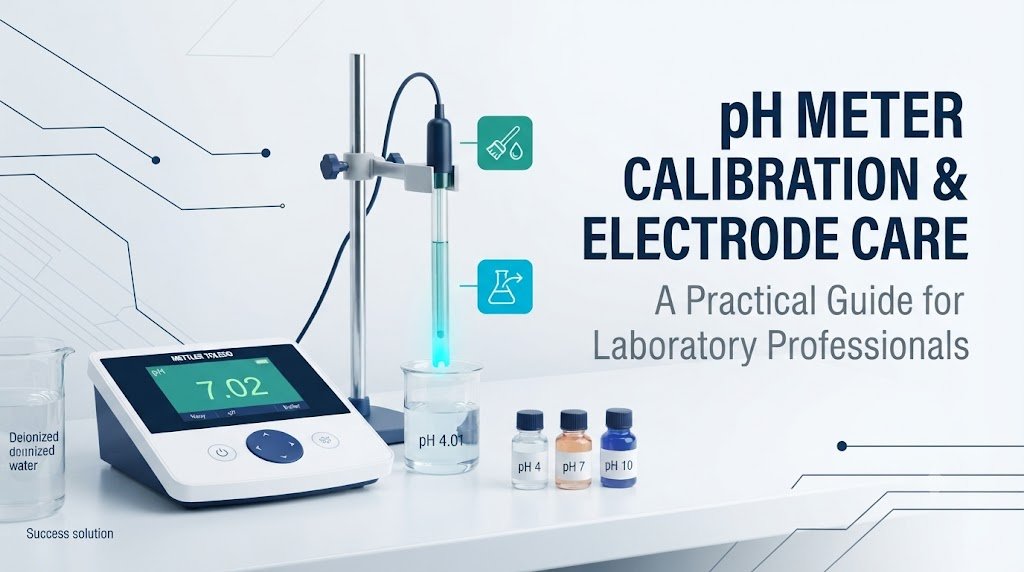
A pH meter is only as good as its last calibration and the condition of its electrode. Most "bad meter" complaints in QC and teaching labs turn out to be a dirty electrode, an old buffer or a dried-out glass bulb. This guide pulls together the routine that Hanna Instruments describes in its electrode maintenance material, with one independent reference on temperature. It is general guidance, so always read the manual of your own meter and electrode.
Why calibration and cleanliness come first
Hanna's guide states that the most common cause of inaccurate pH measurement is a dirty or improperly cleaned electrode, and that an electrode which looks clean is not necessarily clean [1]. During calibration the meter simply assumes the electrode is clean, so a fouled sensor can still be "calibrated" and then give wrong readings once the contamination washes off [1]. The guide sums the routine up as: clean regularly, calibrate often, condition always [1].
Calibrating step by step
Prepare the electrode. For a new electrode, remove the protective cap and look for salt crystals, which form when storage solution evaporates and are normal; rinse them off with water. If the electrode is dry, soak the bulb and junction in storage solution for at least one hour, with an overnight soak being best [1].
Check the fill solution on refillable electrodes. Top it up if the level is low and open the fill cap during calibration and measurement, which gives a better electrolyte flow and a faster, steadier reading [1]. Use the right electrolyte: the guide says single-junction electrodes typically use 3.5 M KCl with AgCl, and double-junction electrodes use 3.5 M KCl [1].
Use two or more points. Calibrate in pH 7.01 first, because this sets the offset; the second buffer sets the slope [1]. Choose buffers that bracket the pH you expect in your samples. The guide's example is a sample near pH 8, which calls for pH 7.01 and pH 10.01 buffers [1].
Rinse and stir. Rinse the electrode with deionised water before and after every solution; the guide says distilled, RO or similar purified water also works for rinsing. A stirrer keeps the solution uniform and speeds the response [1].
Reading slope and offset
Hanna recommends that the offset stays within ±30 mV and that the slope is between 85% and 105% [1]. The offset can be checked by putting the meter in mV mode and reading the electrode in pH 7.01 [1]. If the offset is still outside the range after cleaning, changing the fill solution and using fresh buffer, the electrode may need replacing [1]. Also look at the glass bulb and stem; scratches or cracks mean the electrode should be replaced [1].
The reference point for slope is the theoretical value: about 59.16 mV per pH unit at 25 °C, rising to 54.20 mV at 0 °C and 64.12 mV at 50 °C [3]. That is why a temperature sensor matters. The same source advises calibrating at the same temperature at which you will measure, and notes that the meter compensates for the electrode's temperature behaviour but not for the way the sample's own pH changes with temperature [3].
Looking after your buffers
The guide says calibration is only as good as the buffer. Buffers below pH 7.01 should be used within about 3 to 6 months of opening, and those above pH 7.01 within about 1 to 3 months [1]. Alkaline buffers are less stable because carbon dioxide from the air dissolves in them and shifts their pH [1]. To avoid cross-contamination, do not dip the electrode into the stock bottle and never pour used buffer back; pour a small amount into a separate container and change it often [1].
Cleaning the electrode
Match the cleaner to the deposit. Hanna lists a general-purpose cleaning solution, an enzymatic protein cleaner, an inorganic cleaner (useful for precipitates caused by silver in the fill solution in a ceramic junction) and an oil-and-fat cleaner, each typically as a soak of about 15 minutes, up to 30 minutes for general cleaning [1][2]. After any cleaning, rinse well and then rehydrate in storage solution: at least 2 to 3 hours before calibration according to the maintenance guide, overnight for best results [1]. Do not wipe the glass with a cloth or tissue, since this can damage the sensing glass [2].
Storing the electrode
Keep the glass bulb and junction wet and covered in storage solution, in a beaker or storage cap [1]. If storage solution is not available, Hanna says pH 4.01 or pH 7.01 buffer can be used, but not a buffer above pH 7.01 [1]. Never store an electrode in deionised, distilled or RO water. The guide explains that the 3.5 M KCl reference fill creates an osmotic effect, drawing water in and letting electrolyte leak out, which changes the reference potential and can break down the sensing glass over time [1].
Quick checklist
Inspect the bulb and stem for cracks; check for salt crystals on a new electrode.
Refill and open the fill cap on refillable electrodes before use.
Use fresh buffer in a clean container; note the date you opened each bottle.
Calibrate at pH 7.01 first, then with a second buffer bracketing your samples.
Accept offset within ±30 mV and slope of 85% to 105%; otherwise clean, refresh buffer and repeat.
Rinse before and after every solution; do not wipe the bulb.
Calibrate and measure at the same temperature, with a temperature probe.
Store in storage solution, never in distilled or deionised water.
Conclusion
Reliable pH readings come from a boring routine done consistently: a clean, hydrated electrode, fresh buffers that bracket the sample, and a quick look at slope and offset after every calibration. When the numbers drift outside the recommended window, clean and recalibrate before suspecting the meter, and replace the electrode when cleaning no longer brings it back.
Sources
- Hanna Instruments - pH Electrode Maintenance Guide (PDF) (read 2026-10-20)
- Hanna Instruments Knowledge Base - How do I clean my pH electrode? (read 2026-10-20)
- Metrohm - How temperature influences the pH value (read 2026-10-20)