How a refractometer measures Brix and where it is used
The refractive index principle behind Brix readings, why temperature matters, what Brix does and does not tell you, and where refractometers are used.
Brix is one of the quickest quality checks in food, beverage and process labs: put a drop on a prism, wait a few seconds and read a number. Behind that number is a simple optical idea and a few conditions that decide whether the reading can be trusted. This article explains how a refractometer arrives at Brix, why temperature matters, and where the method fits, using Atago's product material and a general reference on the Brix scale.
The principle: light bends more in denser solutions
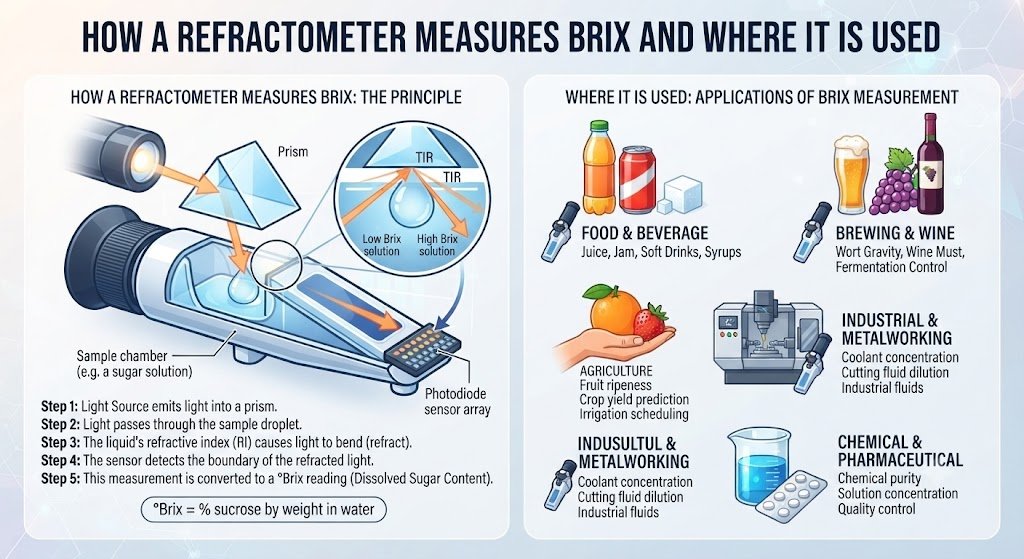
Atago describes refractometry as based on the principle that as the density of a substance increases, its refractive index rises proportionately [2]. Inside the instrument, light passes through the sample at a prism surface and the boundary between a bright and a dark region on the detector marks an angle that depends on the sample, which the instrument converts to a refractive index [2]. For sugar solutions, tables relate refractive index to concentration, and refractometers are calibrated from these tables to read directly in degrees Brix [3].
What a Brix number means
One degree Brix means 1 gram of sucrose in 100 grams of solution, so Brix expresses strength as a percentage by mass [3]. For refractometer work, the underlying refractive index is the value at the sodium D line (589.3 nm) at 20 °C [3]. A handheld meter such as Atago's dual-scale PAL-BX/RI shows both Brix (0.0 to 93.0%, accuracy ±0.1%) and refractive index (1.3306 to 1.5284), and needs only a couple of drops of sample [1]. Benchtop models resolve much finer differences; Atago's RX series catalogue quotes Brix accuracy as fine as ±0.010% on its most accurate models [2].
Why temperature matters
Refractive index changes with temperature, so a Brix reading depends on it too. For sucrose solutions near 10 °Bx or less, a 1 °C change shifts the reading by roughly 0.06 °Bx, and some other liquids, such as beer, shift about three times as much [3]. There are two ways to deal with this. Benchtop instruments can control the sample temperature: Atago's RX series uses a built-in Peltier thermo-module that heats or cools the sample to the set temperature before measuring [2]. Handheld instruments use automatic temperature compensation (ATC); the PAL-BX/RI lists compensation for Brix over 10 to 100 °C [1].
One detail is easy to miss: on the PAL-BX/RI the displayed refractive index is not temperature compensated, and the manual says it is the index of the sample at the temperature displayed [4]. So if you record refractive index rather than Brix, record the temperature too.
Where refractometers are used
Brix is used for wine, fruit juice, carbonated drinks, starch and sugar processing, fresh produce, maple syrup and honey, and also for metalworking cutting fluids [3]. Atago's catalogue says its RX series was developed with the beverage industry in mind and also mentions low-Brix industrial solutions such as surfactants and anti-rust coatings, and high-refractive-index samples such as fragrances and organic solvents [2]. Some instruments let you enter data points to display a concentration scale other than Brix, such as alcohol or salinity [2]. In an Indian setting the same principle applies to a juice line, a sugar or confectionery QC lab or a coolant tank.
Limits of the Brix reading
Brix is defined for sucrose. If the dissolved solids are not pure sucrose, the reading only approximates the dissolved solids content, because different solutes change the refractive index differently [3]. Alcohol also raises refractometer readings, so a fermenting or fermented sample needs a different approach [3]. For such samples a Brix value is best used as a consistent process indicator rather than an absolute concentration, unless you have a method validated for that product.
Quick checklist
Clean and dry the prism, then check the instrument with distilled water at about 20 °C, as accuracy specifications are quoted with water at 20 °C; follow your manual for adjustment [1][4].
Let the sample come to a stable temperature; use ATC or a temperature-controlled benchtop model.
Cover the prism fully with sample and avoid air bubbles.
Record temperature along with refractive index readings.
Remember that Brix is a sucrose-equivalent figure; be cautious with samples containing alcohol or non-sugar solids.
Wipe the prism clean after each sample to avoid carry-over.
Use a consistent method and operator procedure for comparisons between batches.
Conclusion
A refractometer does not measure sugar directly; it measures refractive index and converts it to a sucrose-equivalent percentage. That makes it fast and dependable when temperature is controlled or compensated and when the sample is mainly sugar in water. Where other solids or alcohol are present, treat the reading as an indicator and agree the expected range with your own process data.
Sources
- ATAGO - Dual scale (BX/RI) Refractometer PAL-BX/RI product page (read 2026-10-20)
- ATAGO - Digital Refractometers RX-alpha series catalogue (PDF) (read 2026-10-20)
- Wikipedia - Brix (general reference on the scale) (read 2026-10-20)
- Nova-Tech / ATAGO PAL-BX/RI Digital Pocket Refractometer manual summary (ManualsDir) (read 2026-10-20)